
The Anatomy of Executive Strain
If you are an executive in London, your most dangerous physical activity is likely sitting at your desk. Ten to twelve hours of screen time daily fundamentally alters your musculoskeletal structure. It is not just about feeling "stiff" at the end of the day; it is a progressive mechanical breakdown of your cervical spine and shoulder girdle.
When you sit at a desk, your head incrementally migrates forward. For every inch your head moves forward out of alignment, its weight on your cervical spine effectively doubles. A head that weighs 10 to 12 pounds neutrally suddenly places 30 to 40 pounds of leveraged strain on your neck.
To prevent your head from dropping, your upper trapezius and levator scapulae muscles lock into a state of chronic, isometric contraction. They are literally working overtime, every second you are looking at a screen, just to hold your head up.
Why Stretching Doesn't Fix It
Most of my clients come to me after trying yoga, generic stretching routines, or heat pads. They report that the relief lasts for perhaps twenty minutes before the familiar burn returns. Why?
Because over time, a chronically contracted muscle undergoes physiological changes. It becomes hypoxic (deprived of oxygen), leading to a buildup of metabolic waste. The surrounding fascia—the connective tissue casing the muscle—loses its hydration and becomes fibrotic, literally gluing the muscle fibres together. You cannot simply stretch fibrotic tissue. It requires targeted manual intervention to break down the adhesions.
The Clinical Protocol: Deep Tissue & Cupping
In my 23 years of practice, I have refined a precise protocol for "Desk Worker's Neck." It is not a spa routine; it is an aggressive but calibrated deconstruction of the tension pattern.
Targeting the Trigger Points
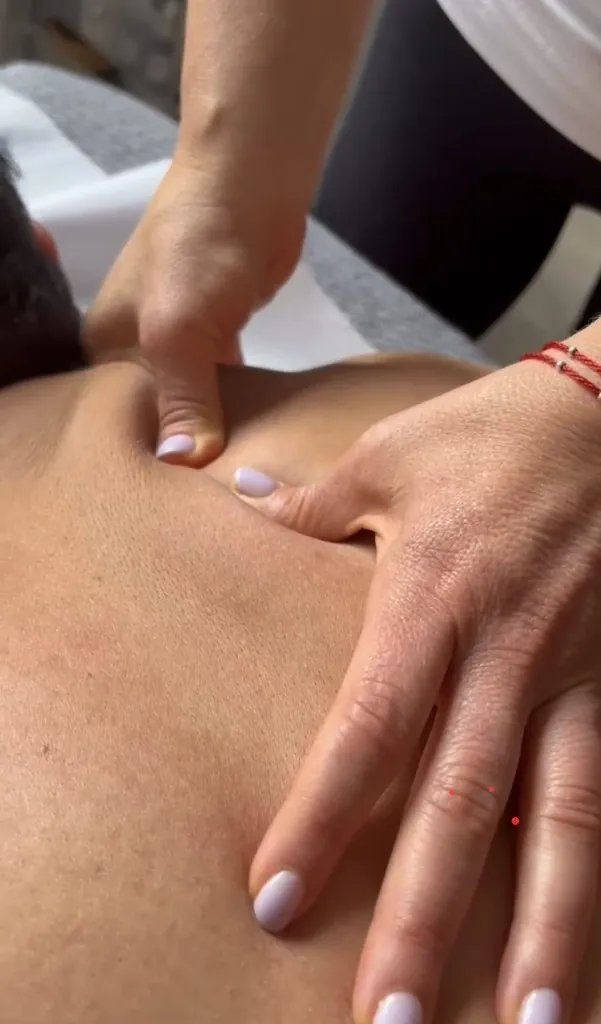
I begin by locating the specific trigger points in the levator scapulae and splenius capitis. These are the hypersensitive nodules that often refer pain into the base of the skull, causing tension headaches. By applying sustained, precise ischemic compression, we force the muscle spindle to reset, allowing the fibre to finally release its death grip.
Following manual manipulation, I frequently employ Myofascial Decompression (Cupping Therapy). While massage pushes tissue down, cupping lifts it up. This negative pressure separates the adhered layers of fascia and pulls stagnant, deoxygenated blood out of the muscle, flooding the area with fresh, nutrient-rich circulation. It is highly effective for thick, stubborn trapezius muscles that resist standard massage.
A 3-Minute Protocol for Your Desk
While clinical intervention is necessary to resolve fibrotic adhesions, you must manage the mechanical load between sessions. Implement this micro-protocol every two hours:
- The Chin Tuck: Sit straight. Without tilting your head up or down, pull your chin straight back as if making a double chin. Hold for 5 seconds. Repeat 10 times. This strengthens the deep cervical flexors that counteract forward head posture.
- Scapular Retraction: Squeeze your shoulder blades together tightly, hold for 3 seconds, and release. Do this 15 times to wake up the rhomboids and lower traps.
- Pectoral Stretch: Desk posture shortens the chest muscles, pulling the shoulders forward. Stand in a doorway, place your forearms on the frame, and gently lean forward to stretch the pecs.
Your Next Session
If you are living with chronic neck and shoulder tension, your body is signalling a mechanical failure. Do not wait for it to become a severe nerve impingement or a chronic migraine issue.